Your resume is the starting point for your interview
Turn the examples on your resume into clear stories you can discuss with confidence when the conversation starts.
 Sofia Chen

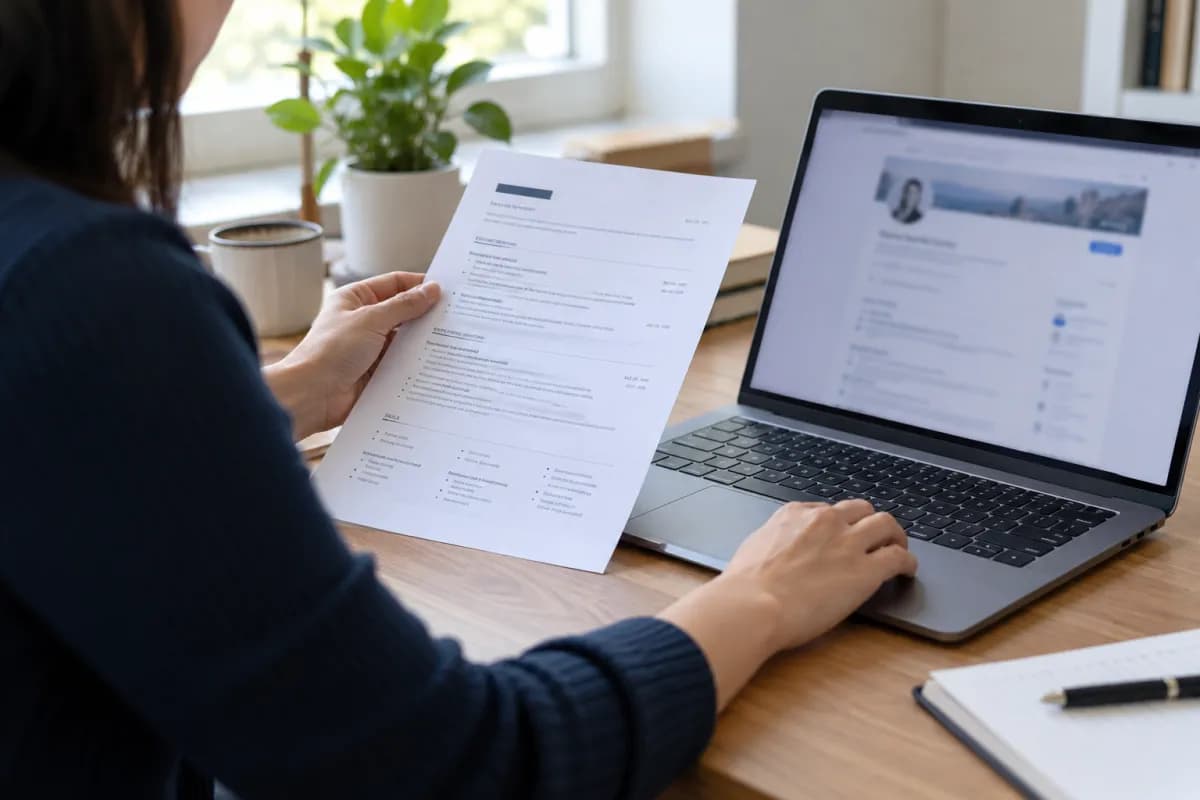
Once you have an interview, your resume becomes a useful preparation document. Each project, role, and skill can prompt a question about what you did and how you worked.
Prepare by revisiting the examples you chose. The goal is to remember the details and explain your thinking in a way another person can follow.
Choose a few examples with range
Highlight experiences that show different parts of your work: solving a problem, collaborating, learning something new, handling a setback, or making a decision with incomplete information.
Choose examples you can discuss in depth. You do not need a separate story for every possible question, but it helps to have more than one kind of experience ready.
Reconstruct the details
For each example, write a few notes about the situation, what you were trying to achieve, the actions you took, and what happened afterward.
Be clear about your own role. If a result belonged to a team, explain who else was involved and which decisions or tasks were yours.
If you included a number on your resume, revisit how it was calculated. You should be able to explain its context and the limits of what it shows.
Practice a clear first answer
Talk through an example out loud. Start with enough context to orient the listener, then move to the work and the result. Leave room for follow-up questions.
You may notice that a sentence on your resume is ambiguous when you try to explain it. That is a useful cue to make the wording more precise for future applications.
Prepare notes you can think from. Memorizing a script can make it harder to adapt when the interviewer asks a different question.
Use a simple structure for your stories
Behavioral questions often begin with “Tell me about a time when...” A common way to organize your answer is the STAR structure: situation, task, action, and result.
Here is an illustrative answer to a question about a difficult deadline:
Our supplier changed a delivery date two weeks before a store opening (situation). I was responsible for the opening schedule (task). I called the other contractors, moved the fittings to a later slot, and sent the store manager a revised plan that day (action). We opened on the original date, and I added a backup supplier to our checklist afterward (result).
Spend most of your time on the action, because that is the part that shows how you work. Aim for about a minute or two, then let the interviewer decide what to explore further.
Prepare for the questions most interviews include
You cannot predict everything, but a few questions come up often. Make short notes on each:
- “Tell me about yourself.” Give a brief summary of your current work, one relevant experience, and why this role is your next step.
- “Why do you want this job?” Name something specific about the role or the team.
- “Why are you leaving your current role?” Stay honest and focus on what you are moving toward.
- “What is a weakness you are working on?” Choose a real example and explain what you are doing about it.
- “What are your salary expectations?” Research the range first, so that you are not deciding on the spot.
Plan the practical details
Small practical problems can use up the attention you need for the conversation. A day or so before the interview, confirm the time, the time zone, and who you will be meeting.
For a video interview, test the link, camera, and microphone, and choose a quiet place with steady lighting. For an in-person interview, plan your route and allow extra time. Bring a printed copy of your resume, a notebook, and any work samples you discussed with the employer.
Prepare your questions too
Use the job description and the conversation so far to identify what you want to understand about the work. You might ask how the team defines success, what the role will focus on first, or how people collaborate.
Review the exact resume version you submitted before the interview. Keep a copy and a few project notes nearby if the format allows it. Preparation works best when it helps you have a thoughtful conversation about the work you could do together.